The Chair We Leave Empty: Honoring Absent Loved Ones Without Staging Grief
Weddings are loud with presence. Every chair has a name card, every table has a centerpiece, every toast has a face behind it. But most couples are also carrying someone who isn't there—a parent, a grandparent, a sibling, a friend. Before I photograph a wedding, I ask about them. Not because I want to create a sad photo, but because I want to make room for them in a way that feels honest.
The first time I asked a bride about her late father, she started crying in the middle of our planning call. Then she thanked me. Nobody had asked her yet. The wedding industry is very good at celebrating what's present. It's less good at acknowledging what's missing.
The Questions I Ask Before the Wedding
I don't lead with 'Who died?' That's not the vibe. Instead, I ask three open questions during our final walk-through or planning call:
- 'Is there anyone who won't be with you on the day who you'd like to feel included?'
- 'Do you have a keepsake, photo, or object that reminds you of them?'
- 'Would you like me to photograph that inclusion, or would you rather keep it private?'
Those questions do two things. They give couples permission to bring it up, and they give me a sense of whether they want the moment documented or just honored. Some people want a photo of the empty chair. Some people want to carry a photo charm on their bouquet and never mention it. Both are valid.
The Difference Between a Tribute and a Trap
The risk with honoring absent loved ones is making the day feel like a memorial service. I've seen well-intentioned plans go sideways: a full table set with place cards for five deceased relatives, a slideshow that runs during dinner, a moment of silence that stretches too long. The couple wanted to feel close to them. Instead, they felt like they were performing grief for an audience.
The best tributes are small and specific. They don't hijack the room. They sit quietly in the background until someone notices. The camera can capture that noticing without making it the whole story.
Small Keepsakes, Quiet Placements
Here are a few ways couples include absent loved ones without turning the wedding into a wake:
A reserved chair. This is the classic. You save a seat in the front row, maybe drape a flower or a piece of fabric over it. The chair does the talking. You don't need a sign.
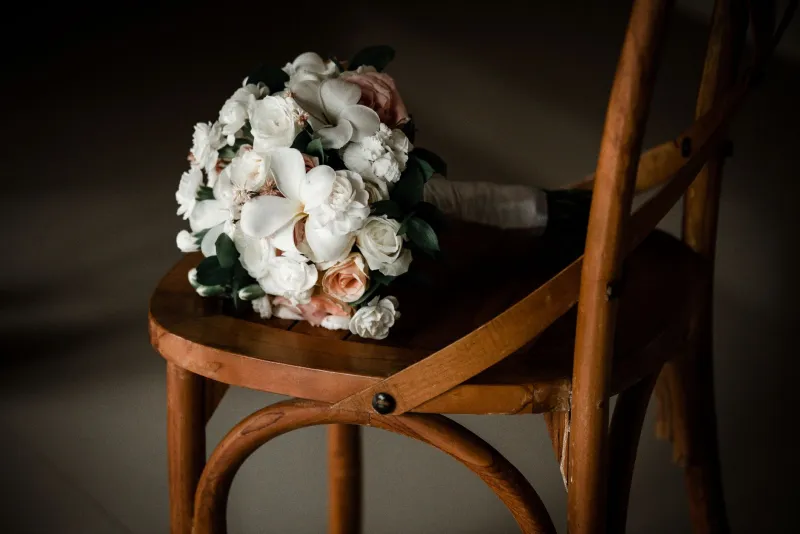
A photo charm. A tiny framed photo attached to your bouquet or pinned inside your jacket. It's private, portable, and photographs beautifully in close-up.
A recipe or a toast. If your grandmother was famous for her pound cake, serve it. If your dad always gave the same toast, have someone give it in his honor. The camera will catch the faces of the people who remember.
A quiet moment before the ceremony. Some couples take thirty seconds alone before the aisle, holding a keepsake or just breathing. No audience. No explanation. I photograph from a distance, if they want me to.
A song. Dedicate a dance or a processional to someone. You don't have to announce it. The people who know will know.
The Empty Chair—and When Not to Use It
The empty chair is powerful, but it's not for everyone. Some couples love it. Others find it too heavy. If you're on the fence, ask yourself: Will this feel like a comfort or a cue to be sad? If you're already worried about crying through your vows, an empty chair in the front row might tip you over. That's okay. You don't have to include it.
If you do want the chair, tell your photographer exactly where it will be and whether you want it photographed. A wide shot of the ceremony can include it without making it the focus. A close-up of the flower on the seat can be a quiet detail. The key is intention. Don't let it be an accident.
How to Brief Your Photographer
You don't need a formal document. A short email is fine. Something like: 'My mom died three years ago. I'm carrying her photo on my bouquet, and we're saving a chair for her in the second row. I'd love one photo of the chair, but I don't want a big deal made of it.' That's perfect. It tells me what to look for, what to avoid, and how much space to give it.
If you'd rather not talk about it in person, write it down. If you'd rather not talk about it at all, that's okay too. But if there's something you want captured, say so. We can't photograph what we don't know to look for.
What to Say in the Moment
If you're the one getting married and you want a moment of acknowledgment, you don't have to make a speech. A pause. A hand on your heart. A glance at the empty chair. Your photographer will see it. You don't have to perform your grief for the camera. You just have to let it be there.
The best wedding photos aren't the ones that show everything. They're the ones that show what mattered. Sometimes that's a dance floor. Sometimes it's a chair.