Aisle View: Why I'll Always Ask for a Phone-Free Ceremony (and the Polite Way to Pull It Off)
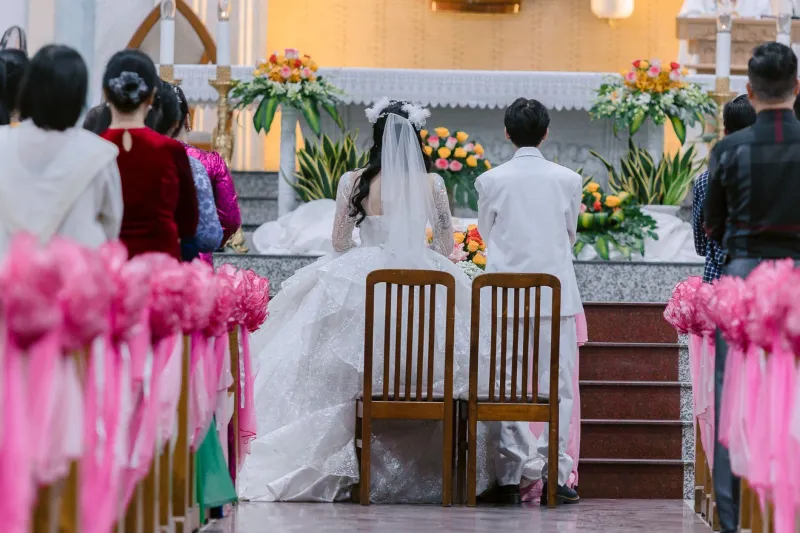
Last June I shot a ceremony in a small stone church in upstate New York. Perfect light, ninety guests, a string trio that had everybody reaching for tissues. And when I pulled up the wide frame from the back of the aisle — the shot I count on for the opening spread of the album — I counted thirty-four glowing rectangles. Thirty-four. Your vows happened behind a wall of iPhones.
That's not a rant about technology. It's a plain description of what winds up in your gallery when the room is full of cameras that aren't mine.
The Shot That Quietly Disappears
Every wedding has a handful of frames the whole album hangs on. One of them is the wide aisle shot: guests turned toward the couple, faces soft, hands still, the room doing that collective holding-of-breath thing. It's the image that tells you what the day felt like before anyone says a word.
When forty people are filming, that shot becomes a portrait of forty screens. I can crop around a few. I can't crop around the back of the room. And it's not just the wides — it's the recessional, the first kiss, the moment your dad's chin starts to go. All of it photographed over somebody's shoulder.
What's Actually Happening in the Aisle
A few things I've seen this year alone:
- A guest stepping into the center aisle during the processional to get a better angle, then staying there.
- Two phones rising into the top third of the frame during the ring exchange, flash on, because someone had their settings wrong.
- A relative crouching in front of the first row while the officiant was talking.
- The recessional — the happiest eighty seconds of the day — photographed entirely through a tunnel of upraised arms.
None of these people were being rude. That's the part couples don't expect. They were being enthusiastic, and nobody had told them what to do instead.
The Part Nobody Warns You About
Here's the one that actually changes your photos rather than just complicating mine: your guests stop watching.
There's a well-worn idea floating around that people remember less of an event when they're busy recording it, and I believe it every time I see it happen. Guests who are framing a shot are working. Their faces go flat. They shuffle for position. The room gets a little less warm, and my job gets a lot harder, because the emotion I'm hired to catch lives on the faces of the people in the seats.
I'm not anti-phone. I'm anti-everyone-missing-it.
Fine — But My Aunt Really Wants Pictures
Fair. Let's be honest about the trade-offs instead of pretending they don't exist.
What you give up with an unplugged ceremony: the guest's-eye view, the chaotic batch of photos your college friends post that night, your cousin's surprisingly good shot of the flower girl. Some relatives will grumble. That's real.
What you don't give up: the reception. Unplugged almost never means the whole day — it means the twenty to forty minutes of ceremony. Cocktail hour and the dance floor are wide open, and that's where the goofy, affectionate guest photos actually live anyway.
And if someone genuinely can't be there — a grandmother in another state, a sibling deployed overseas — say so and let that one person record it. Tell me in advance and I'll frame around them, seat them where they won't be in my sightlines, and use them like a second camera angle. One person is a feature. Thirty-four people is a wall.
How to Ask Without Being a Control Freak
Most couples overthink this. You don't need a rule, you need a sentence — repeated in a few different places so nobody feels ambushed on the day.
Start with the wedding website
Something like: "We're having an unplugged ceremony — our photographer will be the one with the camera, and we want you to be fully here with us. Phones away for the ceremony, then absolutely go wild at the reception."
One line on the site, one in the invitation insert, done. People who read it appreciate the heads-up.
Make the sign short and non-scolding
A sign that says "NO PHONES" reads like a TSA checkpoint. A sign that says "Please put your phones away — we promise the photos will be better than yours, and we really want to see your faces" gets a laugh and gets obeyed. Keep it to two lines at eye level near the entrance, not a billboard at the altar.
Give the officiant twenty seconds
This is the single highest-leverage move, and almost nobody does it right. Ask your officiant to mention it right before the processional starts, once everyone is seated and quiet — not three minutes into the ceremony after the damage is done.
Here's wording that works: "One quick note before we begin — the couple has asked for an unplugged ceremony. Please keep phones and cameras put away, stay seated, and let our photographer do her thing. Then please join us at the reception and take all the pictures you want."
Twenty seconds. Warm, clear, done.
Tell the wedding party first
Wedding parties are the worst offenders, and they mean well. They're in the front row, they have the best angles, and they love you. Give them the heads-up at the rehearsal dinner rather than expecting them to intuit it.
Recruit one gentle enforcer
A cousin, a maid of honor, an uncle with a commanding glare — one person whose only task is the friendly tap on the shoulder. It's a lot easier to enforce when it's your best friend asking rather than the photographer, and I should know: I'm the person standing fifty feet away trying not to make your wedding about my composition.
The Sixty-Second Compromise
If you can't quite commit, there's a middle path I recommend a lot. Have your officiant invite guests to take a photo right after the recessional starts — or have the two of you pause at the back doors for one deliberate phone moment before you walk out.
Everybody gets their shot, you get the photos you actually want, and the ceremony stays clean. It sounds a little silly and I promise it works. The moment the offer is made, the tension drains out of the room.
What I'll Keep Asking For
I'll keep asking because I've seen both versions. I've shot weddings where the ceremony photos are gorgeous and the couple's memories are tangled up in somebody's screen, and I've shot weddings where the whole room simply watched, and the difference is not subtle.
Phone-free for thirty minutes won't cost you a single photo of your guests. It'll get you a better version of every one I take — and you'll still have an entire reception's worth of terrible, beloved, blurry pictures from everyone you love.