The Quiet Ninety: A Wedding Portrait You Didn't Know You Booked
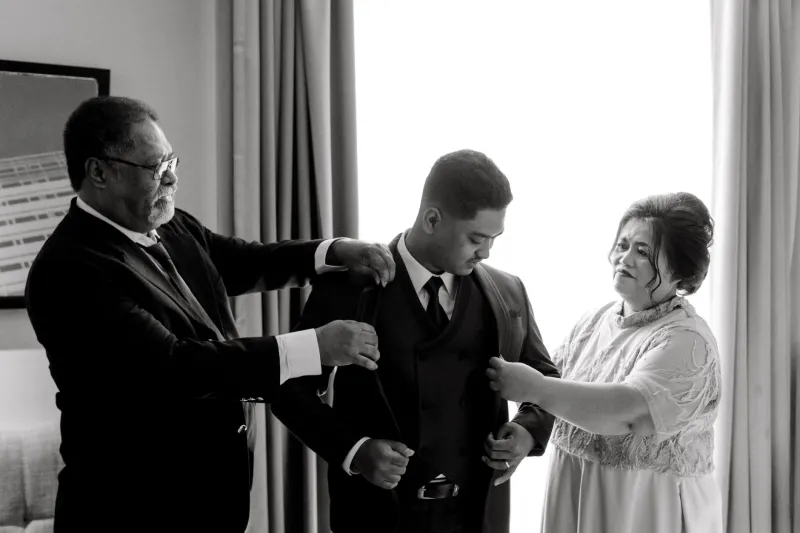
I have a confession: the photo that makes grown adults cry in my delivery galleries is rarely the first kiss. It's not the sparkler exit or the perfectly styled tablescape. It's a slightly crooked frame of a bride sandwiched between her parents, all three of them laughing at something nobody remembers. The light is usually fine, not perfect. Someone's glasses are askew. And it's the image that gets printed, framed, and—more often than I can count—texted to me at Thanksgiving with a heart emoji.
That frame doesn't happen by accident. It happens because we planned for ninety seconds.
Why this portrait gets buried (and why it shouldn't)
Most wedding timelines treat family photos like a shuttle run. You line up with your side, then your partner's side, then grandparents, then the wedding party, then everyone who has ever met you. The camera clicks. People blink. An uncle wanders into the frame. By the time we get to Mom and Dad alone with you, everyone is hungry, the cocktail hour is half over, and the moment feels like a chore.
That's the problem. A formal family lineup is not the same thing as a portrait with your parents. The lineup is about documentation. The portrait is about connection. One is a receipt. The other is a keepsake.
When I ask couples to carve out a separate, quiet ninety seconds with their parents—and grandparents, if they're there—I'm not trying to add another item to the shot list. I'm trying to catch the way your dad looks at you when he thinks the camera isn't watching. I'm trying to get the split-second before your mom fixes your hair and after she decides not to. Those are the frames that age well.
Where the ninety seconds fit without derailing the day
The best slot is usually right after the ceremony, before the cocktail hour swallows everyone. You've just walked back up the aisle. The adrenaline is still humming. Your parents are nearby, emotional, and—crucially—not yet three drinks in.
Here's how I run it: after the formal family combinations are done, I ask the planner to hold the couple for two extra minutes. I release everyone else to the reception. Then I steal the couple and their parents for a short, separate set. No lineup. No barking orders. Just a pocket of quiet near a window, a shaded patio, or the same spot where you just said 'I do.'
If your ceremony and reception are in different locations, we do it at the reception venue before guests sit down. If the day is running late—and it will—I'd rather cut a few formal combinations than skip this. You can live without a photo of your second cousin's plus-one. You will not want to live without the one of your grandmother holding your face in her hands.
What to say when Dad says he hates photos
Every family has one. The father who mutters 'I'll just ruin it.' The grandfather who insists he looks like a boiled owl. The mother who says, 'Oh, I don't need to be in any.'
I have a whole script for this, and it works because it's true: 'This isn't a pose. I just need you to stand here and talk to your kid for a minute. Ignore me.' Then I ask a question that has nothing to do with the camera. What was the first thing you thought when you saw them in the dress? What's one thing you want them to know about staying married? What did they do as a kid that still makes you laugh?
Nine times out of ten, the reluctant parent forgets I'm there. The shoulders drop. The fake smile goes away. And I get the frame.
For grandparents, I keep it even shorter and more physical. No stairs. No long standing. I bring a chair if I need to. I show them the back of the camera after the first few clicks and say, 'See? You look great. Give me thirty more seconds and you're done.' That little proof goes a long way.
The setup that makes it feel like a memory, not a lineup
I place the couple in the middle and the parents slightly turned inward. I ask for a hand on a shoulder or an arm around a waist—something to do with their hands. Then I stop directing and start asking. The best images come from the answer, not the arrangement.
If family dynamics are complicated—divorce, estrangement, a parent who isn't comfortable—I don't force a Hallmark card. I do two shorter sets instead of one big one. Ninety seconds with one side, ninety seconds with the other. Nobody has to pretend. Everyone gets their moment. That's the whole point.
Light matters, but not as much as you'd think. Open shade, a bright window, or the soft edge of a tent beats a perfectly golden sunset if it means Grandma doesn't have to squint. I'll take a technically imperfect frame with real expression over a flawless one where everyone looks like they're waiting for a bus.
The frame you'll actually print
Here's what I know after years of delivering galleries: couples rarely frame the cake. They rarely frame the place cards. They frame the people who showed up. And the portrait with parents—the quiet one, the unposed one, the one where your mom is mid-laugh and your dad has his hand on your back—becomes a family heirloom faster than you'd believe.
Twenty years from now, you won't care that the timeline slipped by four minutes. You'll care that you have proof of the way they looked at you on the day you started your own family. That's worth ninety seconds. Ask your photographer to build it in. Tell your parents it's happening. Then let them forget the camera is there.
I'll handle the rest.