Forget the Pose: How I Get Real Smiles Out of People Who Swear They're Not Photogenic
Somewhere along the way, the internet convinced an entire generation that a good portrait means a hand on the chin, a slight head tilt, and a laugh that looks suspiciously like a cough. I've shot hundreds of sessions across the country, and I'm here to tell you: the Pinterest pose is killing your photos.
Not because it looks bad, exactly. Because it looks like everyone else. And more importantly, it asks you to perform a version of yourself that doesn't exist when nobody's watching — which is exactly when the best photos happen.
The Problem With "Perfect"
I once photographed a couple in Sedona who arrived with a screenshot folder forty images deep. Every pose pre-planned, every angle pre-decided. And you know what? The shots were technically fine. Symmetrical, flattering, forgettable. Their gallery looked like a catalog for people who might be them.
Then, near the end of the session, they stopped to argue — playfully, the way old couples do — about which rock formation looked most like a sleeping bear. I clicked the shutter. That frame, slightly blurry, both of them mid-laugh, is the one they printed at 24 by 36 inches and hung over their fireplace.
That's the moment I stopped directing and started facilitating.
What I Do Instead: Prompts, Not Poses
My sessions look less like a photo studio and more like a weird first date with a chaperone who has a camera. Some of my go-to moves:
- "Walk toward me and tell each other the story of your first date — badly." The retelling is always funnier than the original. Real laughter doesn't need direction.
- "Whisper something in their ear that you can't say out loud on a normal day." I never hear what it is. I don't need to. The expression does the talking.
- The thumb war. Yes, adults. Yes, in a field at golden hour. It works every single time.
- "Look at me, then look away on three." The half-second after they look away is where people stop managing their faces. That's where I live.
- For solo portraits: "Tell me about the best meal you've ever had." Nobody can describe their grandmother's Sunday gravy with a stiff jaw.
Before and After: What Changes
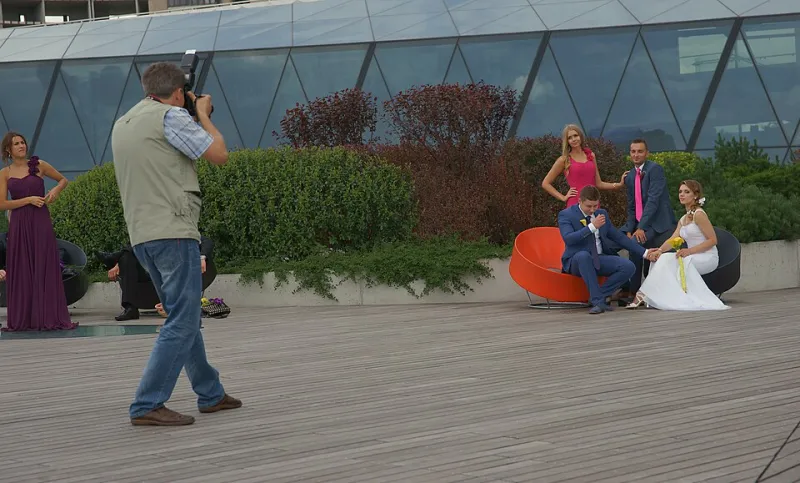
The before shot — the one taken the moment I raise the camera — almost always has it: the held breath, the locked shoulders, the smile calibrated to "pleasant."
The after shot comes thirty seconds later, once the prompt has done its work. Shoulders drop. The smile cracks into something with teeth in it. Eyes actually engage. It's the difference between a photo of you and a photo that is you.
For the Sedona couple, the entire gallery shifted once we abandoned the screenshots. The frames they loved most were the ones where they forgot I was there.
If You Feel Awkward in Front of the Camera, Read This
First: everyone feels awkward. Everyone. The engaged accountant who told me she was "naturally photogenic" was lying to both of us, and her photos came out great anyway.
Second: awkwardness has a half-life. Almost every session has a rough first fifteen minutes where people are stiff and self-conscious. I plan for it. I don't even bring the camera to my face for the first several minutes — we just walk, talk, and let the nervous energy burn off.
Third: bring a person, a playlist, or a purpose. Sessions with your partner, your dog, or a clear reason ("we just bought our first house in Denver") give your hands and your face something to do besides worry about the camera.
And finally: stop expecting to look like someone else. The goal of a portrait isn't to capture the most flattering geometry of your face. It's to capture the thing your best friend would recognize across a crowded room. That thing doesn't pose. It just shows up when something real is happening.
So if you book a session with me and I ask you to race me to the nearest overlook or describe your dream breakfast in detail — just play along. The pose is optional. You're not.