Twelve Hours, Two Batteries, One Incredible Day: What a Wedding Shoot Actually Looks Like From My Side of the Camera
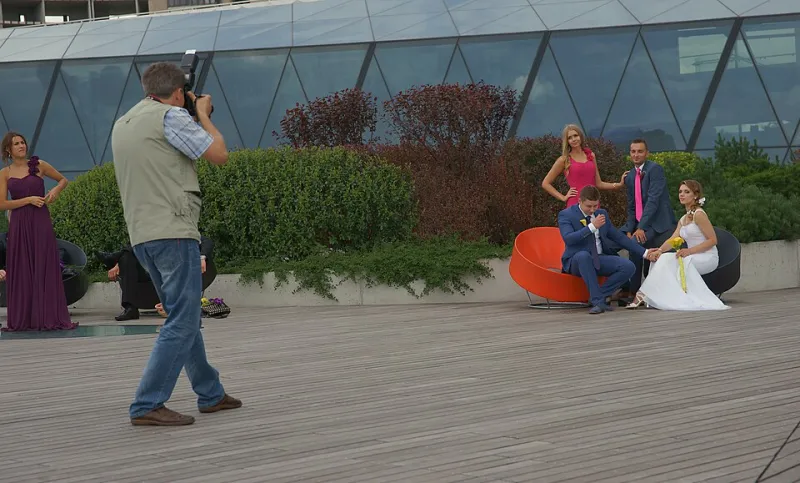
Photo: Brian Toward from London, United Kingdom, CC0, via Wikimedia Commons
Let me paint you a picture. It's 6:47 a.m. on a Saturday in October. I'm parked outside a barn venue outside Asheville, sipping gas station coffee that tastes like regret and motivation in equal measure, watching fog roll off the Blue Ridge Mountains. The wedding doesn't start for five hours. I've already been shooting for twenty minutes, because that fog? That's the shot nobody scheduled.
By the time I get home that night — closer to midnight — I'll have taken somewhere north of 4,000 frames, climbed on and off a ladder at least six times, eaten half a granola bar in a bathroom stall so nobody sees me, and cried exactly once during the father-daughter dance. I don't cry every wedding. But I cry at most of them, and I've stopped apologizing for it.
If you're engaged and trying to figure out what to actually ask of your photographer, I want to pull back the curtain on what a full day looks like from my side. Because the more you understand the machine, the better we can work together.
The Day Actually Starts Before You Think It Does
Most couples assume the work begins when they slip into the dress. Truth is, my day starts with a scout. I walk the venue while it's empty, checking where the light lands at each hour, finding the ugly exit signs I'll need to crop around, and locating the one clean patch of wall for family formals.
Then there's the gear ritual. Two camera bodies, because switching lenses mid-moment is how you miss a first kiss. Batteries charged the night before, memory cards formatted and labeled, a backup of everything important tucked in a separate bag. I've never needed the backup. I carry it anyway, every single time, because "never" is not a guarantee in this business.
Hour Four: Where the Emotional Whiplash Lives
Here's what nobody tells you about shooting a wedding: it's an emotional marathon disguised as a physical one. In a single hour I might go from a quiet, tearful first look to a raucous bridal party toast to a solemn ceremony. My job is to match that energy instantly — to be the calm presence during the vows and the hype man during the reception send-off.
Somewhere in there, I eat. Sort of. Smart couples feed their photographer when the guests eat, and I promise you can tell the difference by hour ten. A photographer who hasn't sat down since 2 p.m. at a 6 p.m. ceremony starts making mistakes around 9 p.m. That's not a criticism of the craft; it's biology.
The physical toll is real too. A full kit — two bodies, a few lenses, flashes, batteries — weighs north of fifteen pounds, and I'm wearing it for twelve hours. My feet file a formal complaint every Sunday.
What You Can Do to Help Your Photographer Crush It
Here's the practical part, and I mean every word of it:
- Build a buffer into your timeline. Give me 10 extra minutes before the ceremony and before the reception grand entrance. Running behind is normal; running behind with no slack means I have to choose between detail shots and candid ones.
- Feed me, and feed me early. Ask your caterer to have a vendor meal ready when the guests are served. A fed photographer is an alert photographer.
- Give me a family photo list, in writing. "All the combos of aunts and cousins" is a recipe for chaos. Names and groupings on a list saves us both twenty minutes and a headache.
- Tell me what actually matters to you. If there's a grandmother who won't be at many more family gatherings, say so. I'll prioritize it. I can't read minds, but I take direction beautifully.
- Trust the timeline we built together. If your coordinator (or a well-meaning uncle) starts moving things, a quick heads-up keeps me in the right room at the right moment.
Why I'd Do It All Over Again Tomorrow
That October wedding outside Asheville? The fog burned off by 10 a.m., the couple ran fifteen minutes late, and the DJ played every cliché in the book. It was also one of the best days of my year. The groom's grandmother slow-danced to Motown. The flower girl fell asleep in a chair and had to be carried out. Real moments, beautifully told — that's the whole job description.
So when you're interviewing photographers and wondering why they charge what they charge, remember: you're not paying for eight hours of standing around with a nice camera. You're paying for the scout, the backups, the second battery, the bathroom-stall granola bar, and the fifteen years of knowing exactly where to stand when the fog rolls off the mountains.